
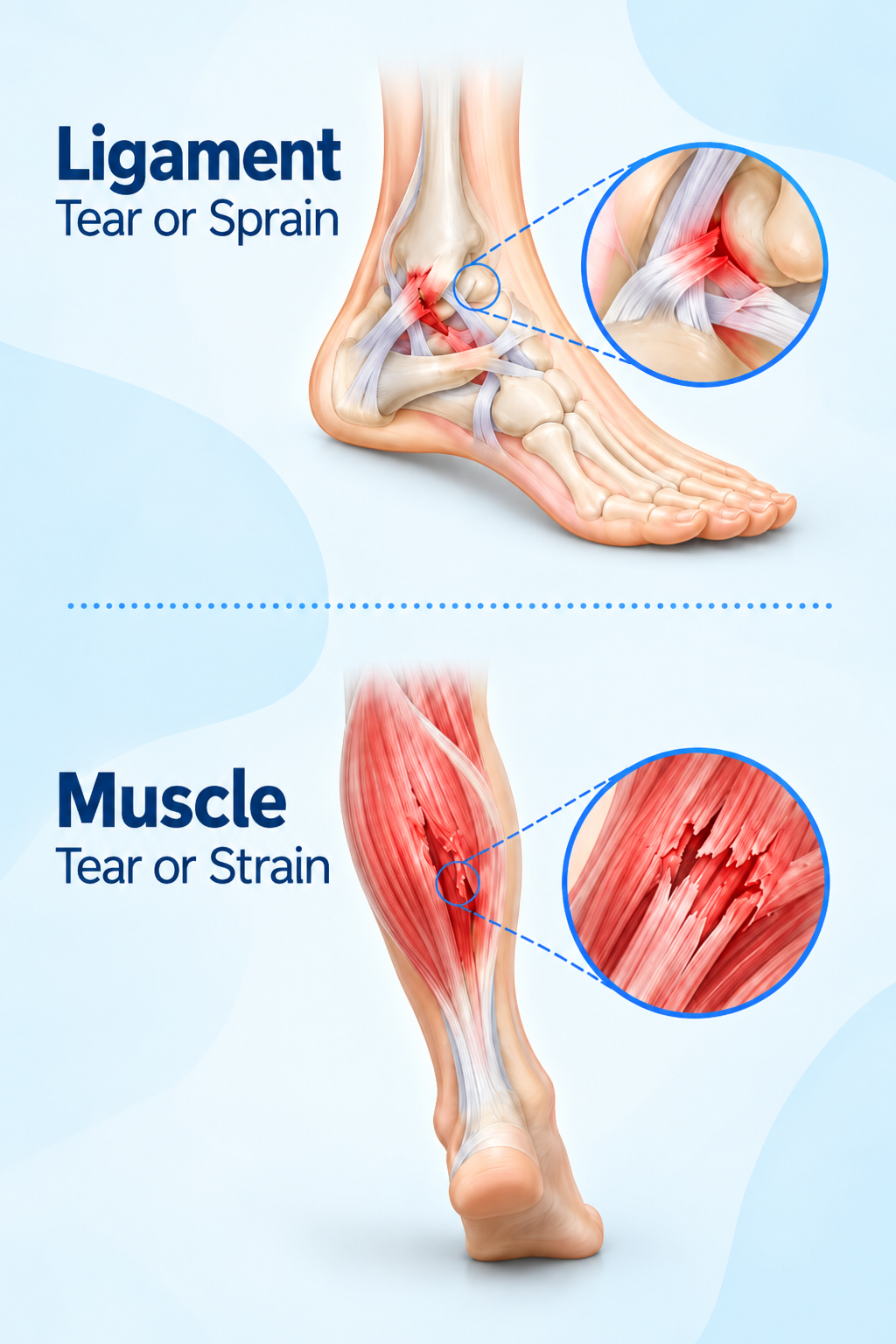
Sprains and Strains
Sprains and strains are common injuries that can occur during daily activities, recreation and competitive sports. But what exactly is a sprain, and how does it differ from a strain?
Sprains
Sprains involve tears of the ligaments and joint capsules (the tissues around joints). Ligaments are bundles of somewhat elastic collagen tissue that attach one bone to another. Meanwhile, joint capsules typically partially or fully surround a joint. In a synovial joint, the capsule contains a lubricating and nourishing fluid called synovial fluid.
Similar to strains, sprains are classified as grade I, II or III, depending on their severity.
- Grade I sprain: A grade I sprain involves a minimal number of torn ligament fibers. As a result, there may be pain, swelling and only mild loss of function.
- Grade II sprain: A grade II sprain involves a moderate or partial ligament tear. In this case, moderate to severe pain, swelling and bruising are common, along with reduced joint function. For example, walking on an ankle affected by a grade II sprain may be extremely difficult or even impossible.
- Grade III sprain: A grade III sprain involves a complete tear of the ligament or joint capsule. Severe pain, swelling, bruising and loss of function may occur. Depending on the extent of the injury, orthopaedic assessment and, in some cases, surgical repair may be necessary.
Strains
A strain occurs when muscle fibers or the muscle-tendon unit are overstretched or torn. Muscle fibers are the individual units that make up your muscles. When a muscle is subjected to strong or repeated contractions, a strain may develop. Like sprains, strains are classified into three grades according to severity: mild (grade I), moderate (grade II) and severe (grade III).
- Grade I strain: A grade I strain involves mild damage to the muscle fibers. Typically, there may be slight swelling and tenderness, and stretching or using the injured muscle may cause discomfort.
- Grade II strain: A grade II strain indicates moderate muscle fiber damage. Consequently, pain may range from moderate to severe, and using or stretching the injured muscle can be difficult. Bruising, also known as ecchymosis, may also be present. This occurs when damaged blood vessels cause bleeding within and around the muscle. As the blood spreads beneath the skin, discoloration may appear purple, blue, red, yellow or green.
- Grade III strain: A grade III strain is the most severe type of muscle strain. It involves a complete tear of the muscle or separation of the muscle from its tendon. Symptoms may include severe pain, substantial or complete loss of muscle strength, swelling and bruising. In some cases, a noticeable indentation may be felt where the muscle has torn. Therefore, prompt medical evaluation is important. An orthopaedic specialist may assess the injury and determine whether surgical repair is necessary.

Tendinitis
Tendinitis is a common condition that affects the tendons and bursae in the body. It can cause pain, inflammation and limited range of motion, making it difficult to carry out everyday activities.
What Is Tendinitis?
Tendinitis is the inflammation of a tendon, a fibrous cord that attaches muscle to bone. It can occur in any tendon in the body but is most common in the shoulder, elbow, wrist, knee and ankle.
Repetitive motion, overuse and poor posture are common causes of tendinitis. Symptoms include pain, swelling and limited mobility of the affected joint.
How Can Physiotherapy Help With Tendinitis?
Physiotherapy can help manage tendinitis and bursitis by reducing pain and inflammation, improving range of motion and restoring function.
We will assess your condition and develop a personalized treatment plan that may include:
Exercise Therapy:
We may prescribe exercises to strengthen the affected muscle, apply a tensile load to the tendon to support healing, and use flexibility exercises to restore range of motion.
Manual Therapy:
This involves hands-on techniques on the affected area to reduce pain and inflammation and improve mobility.
Modalities:
We may use options such as ice or heat therapy, laser therapy, shockwave therapy or electrical stimulation to reduce pain and inflammation.
Education:
We will explain our treatment approach based on your needs, goals and current best clinical evidence. We will also provide you with a home program.
Let Us Help You Heal
If you’re experiencing pain, swelling or limited range of motion in any joint, consult a physiotherapist for an evaluation. Early intervention can help prevent further damage and improve your quality of life. Physiotherapy can help with tendinitis (also spelled tendonitis), sprains and strains.