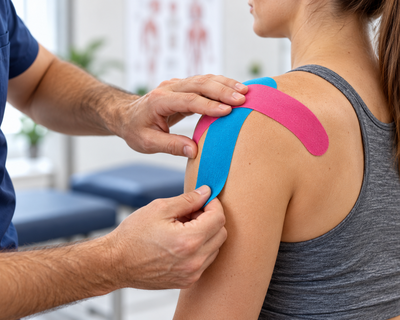
Kinesio Taping in Mississauga
At Kingsbridge Physiotherapy Centre in Mississauga, we use Kinesio® Tape to support muscles and joints while allowing natural movement. Our physiotherapists may use kinesiology taping as part of your treatment plan to help manage pain, swelling, and muscle strain.

What Is Kinesio® Tape?
Japanese chiropractor Dr. Kenzo Kase invented Kinesio® Tape in 1979, after extensive research in kinesiology, the science of muscle and skeletal movement. Dr. Kase developed both the method and the first elastic therapeutic tape, Kinesio Tape. He founded the company Kinesio in the 1980s and formed the Kinesio Taping Association (KTA) in 1984. Kinesio USA, LLC began operating in 1994, and its headquarters is in Albuquerque, New Mexico.
Kinesio® Tape is a latex-free, elastic, porous cotton strip with an acrylic adhesive. Practitioners use it for athletic injuries and many other physical disorders. The tape stretches up to 140% of its original length, which allows a much greater range of motion than traditional white athletic tape. It can also stay on for up to 4 days before you need to replace it.
The tape is about as thick as human skin (epidermis) and its design copies the skin’s elasticity. It aims to ease pain, reduce inflammation, relax muscles, improve performance, help rehabilitation, and support muscles during a sporting event.
The Kinesio Taping® (KT) Method is the rehabilitative use of Kinesio® Tape to support the body’s natural healing process. It gives support and stability to muscles and joints without limiting range of motion. You can use taping alongside the hands-on treatment you receive in the clinic.
The Four Major Functions of Kinesio Taping®
According to Dr. Kase, Kinesio Taping® has four major functions:
1
Supporting the muscle
Proper taping improves the muscle’s ability to contract, even when it is weak. It reduces the feeling of pain and fatigue and protects the muscle from cramping, over-extension and over-contraction.
2
Removing congestion in the flow of body fluids
Kinesiology tape improves blood and lymphatic circulation and reduces inflammation and excess chemical buildup in the tissue.
3
Activating the endogenous analgesic system
“Endogenous” means self-originating, and “analgesic” means able to relieve pain in a conscious person. So the tape must support the body’s own healing mechanisms, a central focus of chiropractic medicine.
4
Correcting joint problems
The goal is to improve range of motion and adjust misalignments caused by tight muscles.
These four functions drive the technology behind the tape. Its top side is very thin, highly elastic, porous cotton that lets the skin breathe. Its underside is a sticky, water-repellent, medical-grade acrylic adhesive that further supports muscles and connective tissue. By targeting different receptors in the somatosensory system, Kinesio® Tape eases pain and helps lymphatic drainage by lifting the skin at a microscopic level, which reduces swelling and inflammation. The tape can be applied in hundreds of ways. It can re-educate the neuromuscular system, reduce pain and inflammation, improve performance, help prevent injury, promote good circulation and healing, and help return the body to homeostasis (internal conditions staying stable and fairly constant).
How Is Kinesio® Tape Applied?
Kinesio® Tape is applied using five general cuts, or techniques:
- The “Y” cut: The most commonly used. It is used for muscles such as the deltoid (the muscle that forms the rounded shape of the shoulder), because it can wrap around the muscle to calm or activate its signals.
- The “I” cut: Used for acute injuries in small or narrow areas, mainly for edema (a collection of fluid in the spaces between cells, or swelling) and pain. For example, an I-shaped strip can be applied to the teres minor (the muscle that rotates the arm outward and helps bring it toward the body) or the rhomboid minor (a small back muscle that connects the scapula to the vertebrae of the spine).
- The “X” cut: Used for muscles that change with movement, such as the biceps femoris (a two-headed muscle at the back of the thigh that extends the hip and bends the knee).
- The “Fan” cut: Covers a large area and allows flexible placement, which helps guide lymph drainage more effectively and reduce edema (swelling). It is commonly used for lymphedema (a backup or congestion of lymphatic fluid), because the tape allows better lymph drainage. As the body moves, the tape acts like a pump and keeps the lymph circulating 24 hours a day. The “Web” cut is just a modified fan cut, where both base ends are left intact with strips being cut in the middle part of the Kinesio strip.
- The “Donut” cut: Mainly used for edema in a focused or sport-specific area. Overlapping strips are used, and the center is cut out over the area being treated.
Correct Tension Is Key
Correct tension is also key to success with Kinesio Taping:
- For muscles that are injured or overused and need relief from pain and tightness, the tape is applied with no tension. It starts at the tendons that attach the muscle to the bone and extends toward the origin of the muscle.
- For muscles that are chronically injured or weak and need support and full range of motion, the tape is applied with light tension. It starts at the origin of the muscle and extends toward the tendons that attach the muscle to the bone.
In some cases, treating a patient’s condition may also mean treating other underlying conditions. The Certified Kinesio Taping Practitioner (CKTP) may need to do assessments such as manual muscle testing, range of motion (ROM) testing, gait assessment and any other orthopedic special tests needed to decide the best treatment for the patient’s needs.
Before and After the Tape Is Applied
Before applying the tape, the Certified Kinesio Taping Practitioner makes sure your skin is clean and free of oil, sweat and lotion. Otherwise, the tape will lose its stickiness. After application, the practitioner rubs the tape to activate the heat-sensitive glue. The glue needs about 30 to 60 minutes to fully activate before you can be physically active or shower. If you are active before then, the tape may come off.
A small amount of body hair will not affect how well the tape works or sticks. However, areas with a lot of hair should be clipped or shaved for the best results and less pain when the tape is removed.
Kinesio® Tape FAQs
How is Kinesio® Taping different from the traditional McConnell method of athletic taping?
Traditional athletic taping often restricts movement to stabilise a joint or protect an injured area. Kinesiology tape stretches with your skin and aims to provide support without significantly limiting movement.
Your physiotherapist will recommend the approach that best suits your injury, activity level, and recovery goals.
How do I take the tape off?
To remove Kinesio® tape safely, peel it off slowly and gently to minimize discomfort and reduce the risk of skin irritation. Removing the tape after a bath or shower, when it is damp, may help make the process easier.
Gradually peel the tape back while supporting the skin and following the direction of hair growth. If you experience pain, skin damage, or difficulty removing the tape, consult your physiotherapist for guidance.
Can I apply Kinesio® Tape myself?
You can buy kinesiology tape for home use, but correct placement and tension depend on your condition and treatment goals.
A qualified physiotherapist can assess your symptoms and show you how to apply the tape safely if home use is appropriate. Avoid using tape to treat an undiagnosed injury or replacing necessary medical care with taping.
How do I look after Kinesio® Tape once it's on?
- Pat the tape dry with a towel after showering, swimming, or exercising.
- Avoid rubbing the tape or pulling at its edges.
- Trim loose edges carefully if your practitioner advises you to do so.
- Avoid using a hair dryer to dry the tape.
- Remove the tape if you develop significant itching, redness, blistering, or other signs of skin irritation.